

Fibonacci Sunflower Spiral
Brand 9 Signs designs and hand-builds 3D wall art in-house from our Orange Park FL shop - dimensional routed wood, mixed media, and hand-applied finishes, made to order. Vertically integrated since 1986: our own studio develops each piece for the wall it is going on across Florida, the Southeast, and US.



About the work
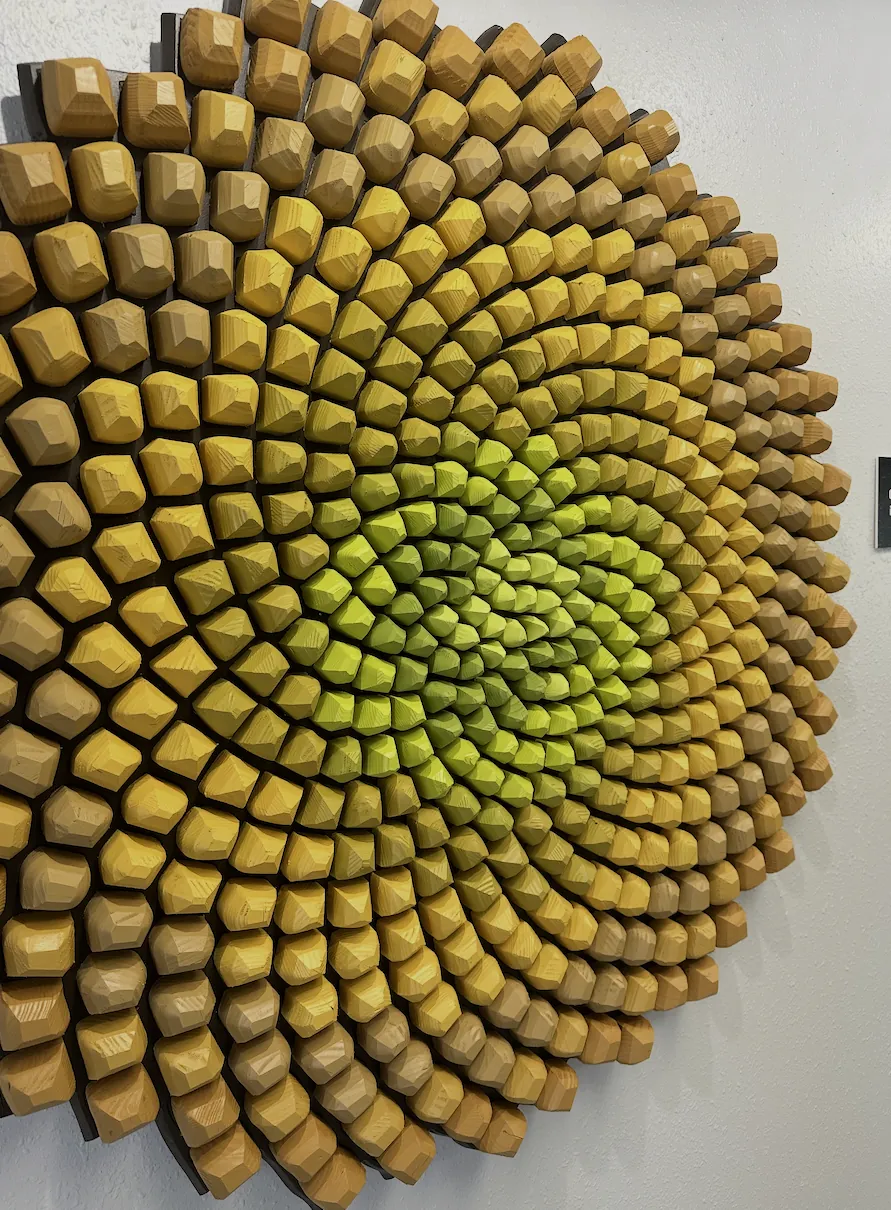
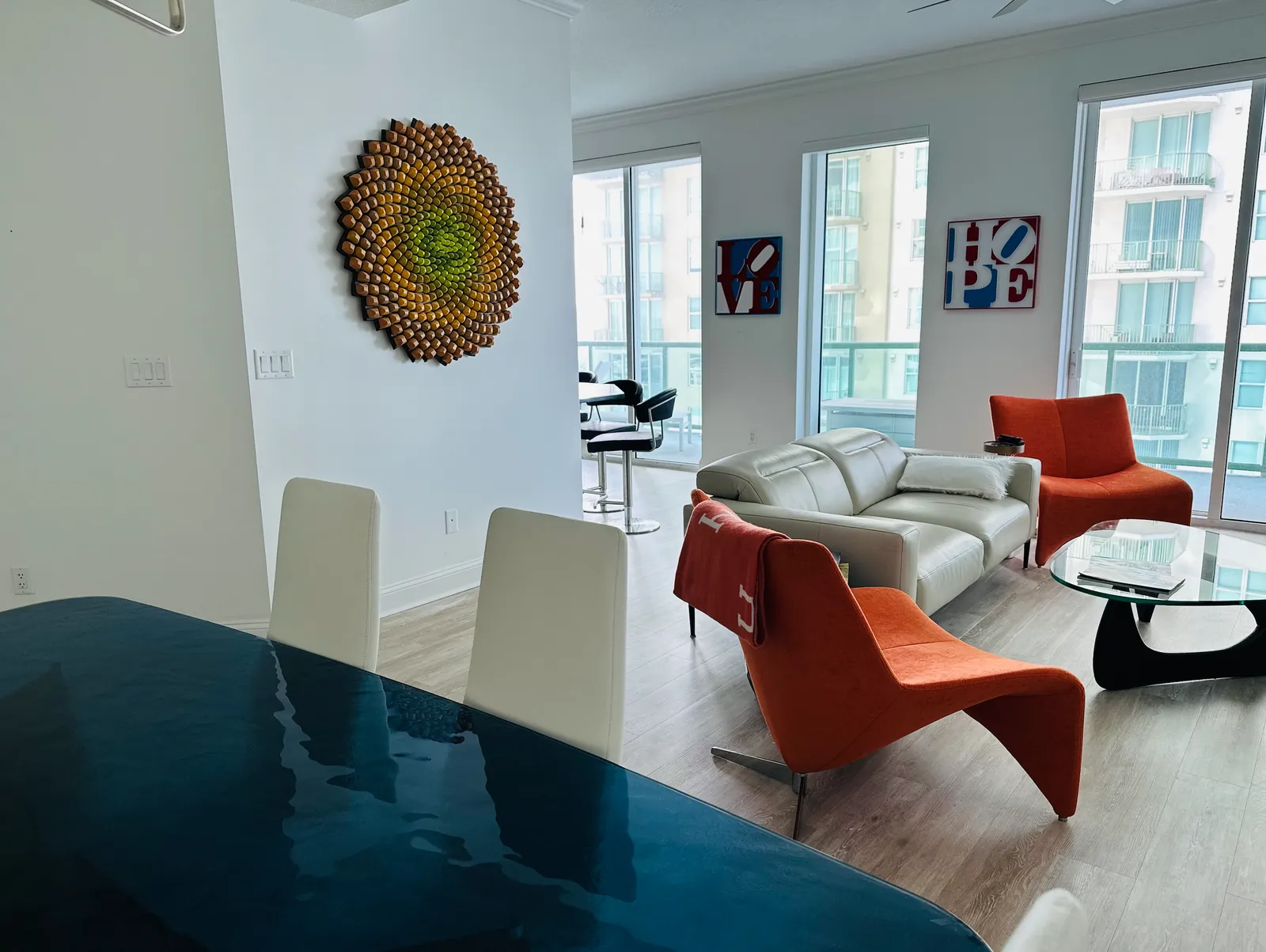
The Fibonacci Sunflower Spiral is built from 441 individually cut blocks in ten tones of lumber and plywood, each one faceted and finished by hand, then set in interlocking spirals that run from a chartreuse center out to amber and tan at the rim. Because every block is cut and faceted separately, no two catch the light the same way, and the piece changes as you move past it. The original hangs in a private residence in Ponte Vedra Beach, Florida.
The sequence
The Fibonacci sequence was set down in India as early as 450 B.C., in the work of Pingala on Sanskrit prosody. It reached Europe in 1202, when Leonardo of Pisa used it in Liber Abaci, the Book of Calculation, to model the growth of a rabbit population. The name we use for it was coined much later, in the nineteenth century, by the number theorist Édouard Lucas. The rule is as simple as arithmetic gets: 0, 1, 1, 2, 3, 5, 8, 13, 21, 34, 55, 89, 144… each number is the sum of the two before it.
What makes it unusual is that it belongs to mathematics and to biology at once. It turns up in the run-time analysis of Euclid’s algorithm for the greatest common divisor. It also turns up in the branching of trees, the arrangement of leaves on a stem, the fruitlets of a pineapple, the bracts of an artichoke, the scales of a pine cone, the family trees of honeybees — and in the florets packed into the head of a sunflower, which Helmut Vogel modeled in 1979 using the golden angle, 137.5 degrees. It is the same packing you are looking at here. You can drag the angle yourself and watch every other value fail →
Patterns of nature, and sacred geometry
The ratio the sequence converges on — roughly 1.618, the golden ratio — sits at the heart of what is traditionally called sacred geometry: the long habit, across cultures, of treating proportion and pattern as meaningful rather than merely useful. Some of the claims made in that tradition are contested and some are not. What is not in dispute is that designers have reached for the golden section deliberately for centuries, and still do: Le Corbusier built an entire proportional system, the Modulor, on it.
The work in the Patterns of Nature group takes the uncontested part. Phyllotaxis — the spiral packing of leaves and florets — is a real solution to a real problem, which is how to fit the most growth into the least space without any two elements shadowing each other. A sunflower head is an answer arrived at without a designer. Carving one at four feet across, block by block, is a way of looking at that answer slowly.
About the artist
Bobby Hartley grew up drawing, and selling. At ten he was collecting sand dollars on vacation, drawing on them and selling them. By seventh grade he was taking his wood shop projects around the neighborhood with an order form. His parents ran their own businesses, and in 1986 the family opened the sign shop in Orange Park that became Brand 9 Signs.
He studied design as an undergraduate with a minor in art history, took a graduate degree on a marketing track, and later studied at Harvard Business School. Along the way he worked on early architectural visualization software — the kind later bought by Autodesk — building renderings for home and commercial builders. He has been thinking in three dimensions for a living most of his career.
Then forty years in the sign trade: carving, routing, painting and installing dimensional work for other people’s brands, in about twenty-five states and as far away as Japan. The Patterns of Nature pieces are that same hand turned to his own subjects.
In his words
The interest in number and pattern started in those design classes and never left — the way one sequence keeps showing up in a pine cone, a nautilus shell, the head of a sunflower.
Everything is in motion, and things vibrating near each other tend to fall into step. Fireflies do it. I think good work does it too. It should resonate with the person standing in front of it, whether or not they can say why.
These pieces are made from natural materials. They hold their balance, and they change as you move past them. They leave me calm and focused, which is what I’m after.
— Bobby Hartley
Other work: The Violet Aster · The Florida Keys · Manhattan · NYC HOPE
Commission dimensional hand-painted wall art →
Specification
- Size
- 48″ × 48″ × 2″ (approximate)
- Weight
- Approximately 50 lb
- Projection
- About 2¾″ off the wall face, including the 3/4″ float mount built into the back
- Build
- Carved solid lumber on an exterior marine-grade plywood backer, hand-painted in acrylic
- Lead time
- 6–8 weeks from deposit for a comparable commission
The work, the specification, who makes it, and how a commission runs — written for art consultants, interior designers and FF&E specifiers.
Tell us about the wall.
The wall, the room, the light, and the date it has to be up. We come back with a price and a lead time.
- 15-minute callback Mon–Fri, 8:30am–5pm
- One shop Carved, finished, crated and hung by our own crew
- 6–8 weeks from deposit, confirmed at quotation
Prefer to talk? (904) 272-3395