

Why Commissioned Art Costs What It Costs
441 blocks, ten tones, every facet cut by hand — and one wall it will never leave.

A commissioned piece is not a better version of something you could buy. It is a different transaction. What you buy in a shop already exists; someone decided its size, its palette and its subject before knowing where it would hang. A commission runs the other way. The wall comes first — its width, its light, what it faces, who walks past it and how fast — and the work is made to that, once, and not made again.
That is the whole of it, and it is also the reason for the price. What follows is the arithmetic.
441 blocks, and what that number means
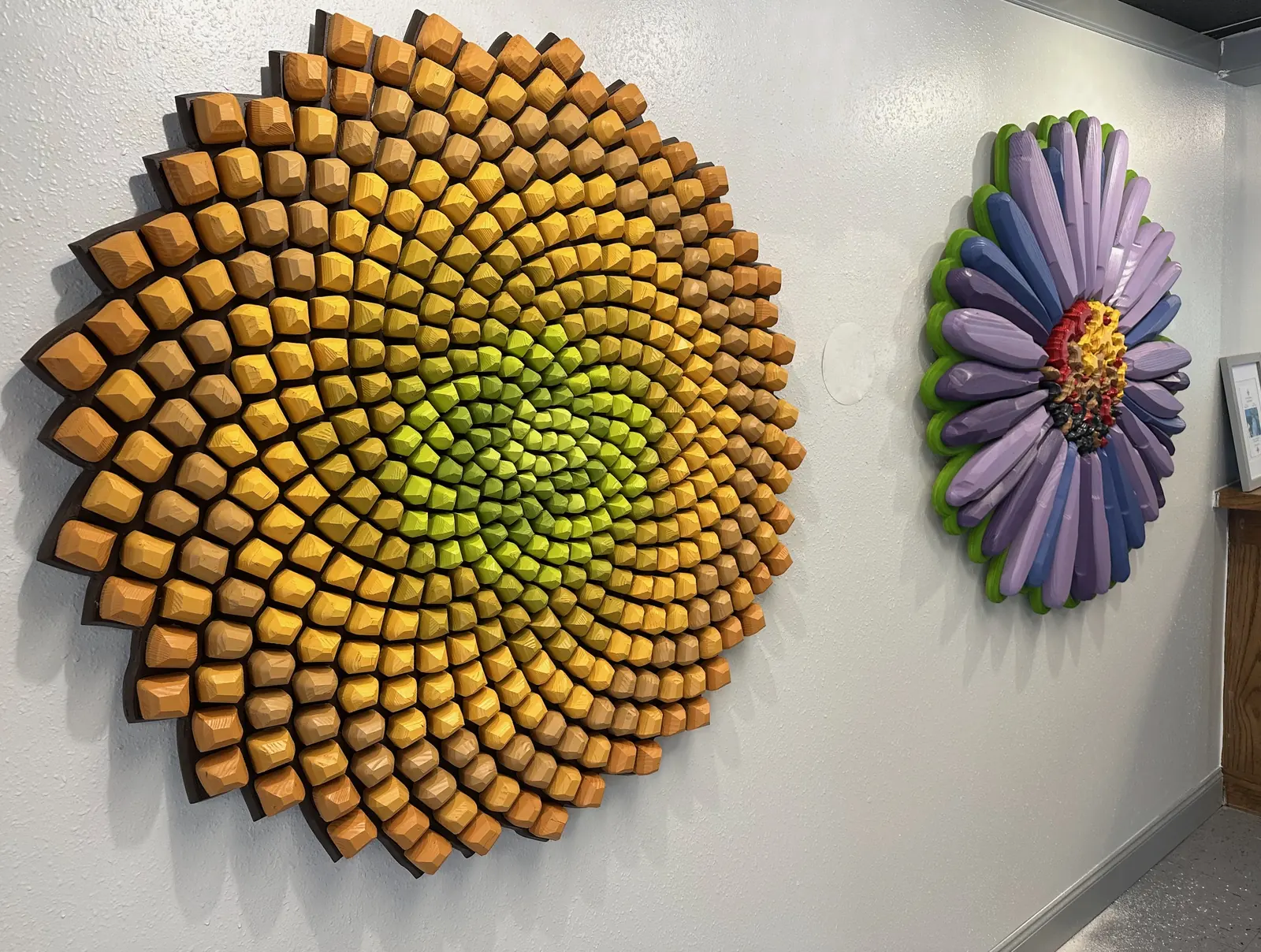
The Fibonacci Sunflower Spiral is built from 441 individually cut blocks in ten tones of lumber and plywood. Not 441 printed shapes, and not 441 identical pieces from one jig. Each block is cut, then faceted by hand so its top face catches light at its own angle, then finished, then set into interlocking spirals that run from a chartreuse center out to amber and tan at the rim.
The Violet Aster is a different problem solved the same way: 59 pieces, counting the green ground they sit on. The petals are long and carved, laid in two overlapping layers in violet, lilac and periwinkle, each one shaped and finished individually so the light crosses them at different rates. Walk past it and the piece changes. The center is built separately, close-packed in red, yellow and black.
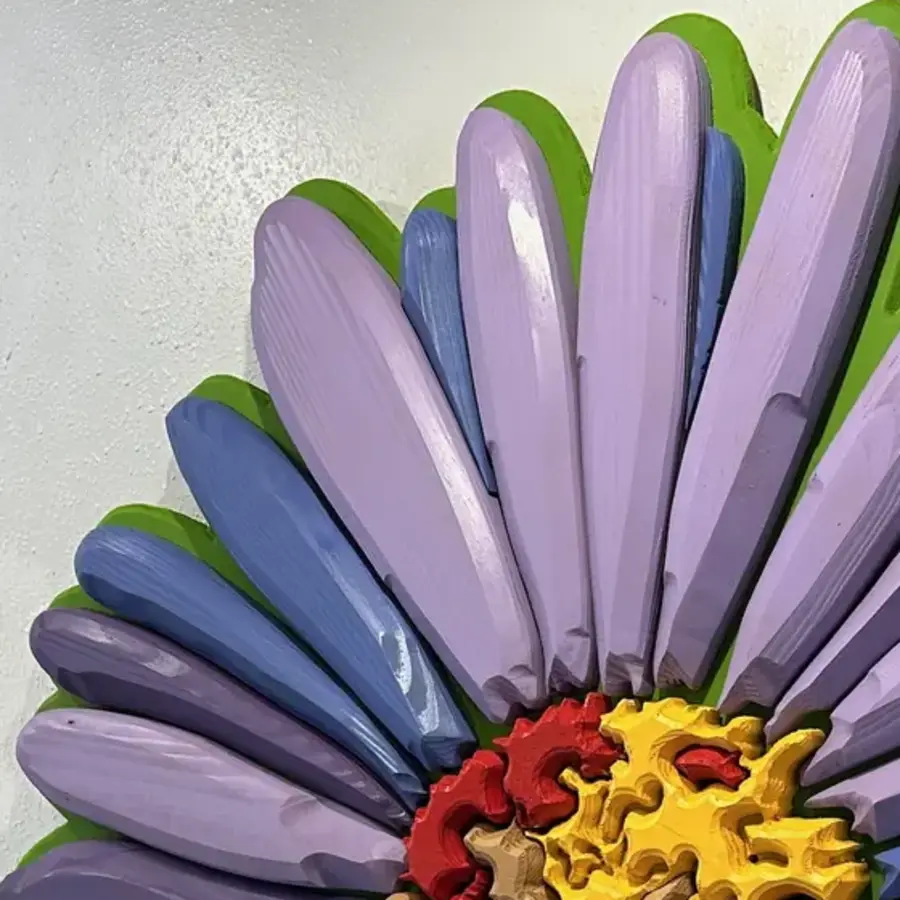
Those numbers are not trivia. They are hours, and they are the only honest answer to what a piece costs. A machine can cut 441 blocks in an afternoon. It cannot decide which way each facet should fall, and it is the deciding that takes the time.
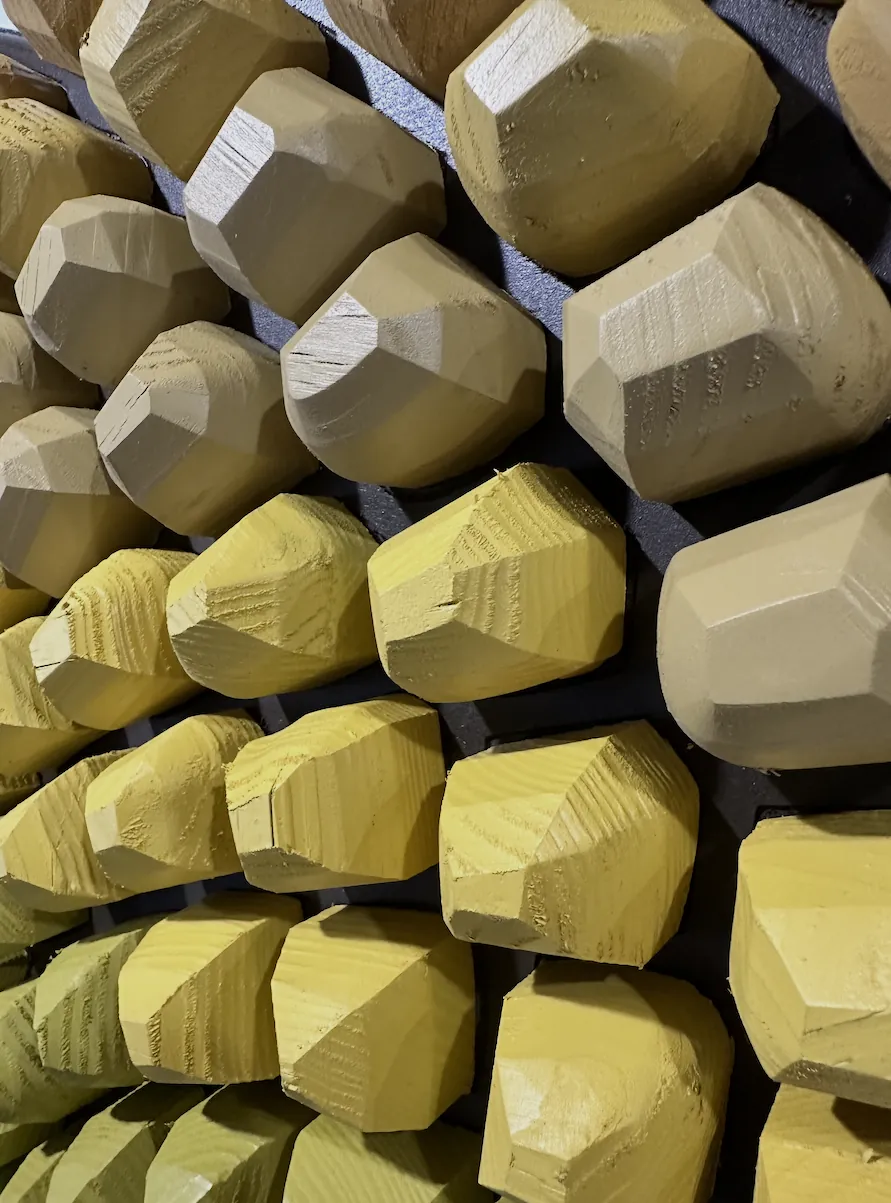
The geometry is the subject, not the decoration
The spiral in the sunflower is not a motif chosen because it looked good. A sunflower places each seed roughly 137.5° around from the last one — the golden angle — and that specific angle is the only one at which no two seeds ever fall into step. Every other fraction of a turn eventually repeats, the seeds line up in spokes, and some of them end up shadowed by others. The plant is solving a packing problem, and the pattern is the solution.
You can watch that happen: turn the dial on the golden angle and every angle except one collapses into spokes. The same reasoning governs how signage gets placed across a community — put two monuments on one sightline and you have hidden one of them — which is how a sign shop came to be building this work in the first place.
Who makes it
The pieces are made by Bobby Hartley, who runs Brand 9 Signs. The company has been fabricating architectural signage in Orange Park, Florida since 1986 and has completed more than 250 community projects. Before that he worked at the front edge of architectural visualization software, building renderings for homebuilders and commercial builders, and he is a Harvard Business School alumnus.
That combination matters more than it sounds. The work is made in a shop that builds things which have to survive Florida outdoors, by someone who has spent a career on how a building is read from across a parking lot. It is not a studio practice that learned fabrication; it is a fabrication practice that turned to making art.
Built like architecture, not like a picture
Each piece is roughly 48″ square and 2″ deep and weighs around 50 lb. The relief is built from a range of lumber — cedar through pressure-treated stock, specified to where the piece is going — over a backer and float mount in exterior marine-grade plywood, and finished in acrylic paint.
The float mount is 3/4″ deep and built into the back, so the piece stands about 2 3/4″ off the wall face and throws its own shadow. That shadow is part of the work; it is the reason the piece reads as depth rather than as a printed image of depth.
Because of how it is built, a piece can hang inside or outside. Very little art can. That single fact opens walls most collectors have written off — a covered entry, a courtyard, a pool deck, a loggia — and it is the most common reason a piece ends up where it does.
How a commission works
It starts with the wall. Dimensions, light, what the piece will be seen against and from how far. From there the work is developed for that specific placement — scale, palette, depth and subject — and only then built.
Terms are a 50% deposit to begin, with the balance due before delivery or at installation. Lead time is six to eight weeks. Installation is by the same crew that installs the architectural work.
Pieces are priced individually against scale, complexity and placement. A current schedule is available privately on request — there is no list price, because there is no list.
What you are actually buying
Not a size and a colorway. You are buying the hours of one pair of hands, a geometry that is doing real work rather than decorating, a build specified to survive where you want to put it, and the fact that the piece on your wall is the only one of itself that will ever exist.
Both lead works — the Fibonacci Sunflower Spiral and The Violet Aster — currently hang together in a private residence in Ponte Vedra Beach. See the commissioned work, or start a conversation about a wall.
Have a wall in mind?
Commissions begin with the wall — its size, its light and what it faces. Tell us about it and we will take it from there.